
A sales pipeline is a visual representation of where your potential customers are in their buying journey. It provides sales teams with a clear overview of every open opportunity and the specific steps required to turn a lead into a paying client. For any business aiming for consistent growth, understanding and managing a sales pipeline is essential because it allows managers to track progress and predict future revenue with higher accuracy. By organizing prospects into distinct stages, companies can identify where deals might be getting stuck and take proactive measures to keep the momentum going. This structured approach ensures that no potential customer is forgotten and that the sales team remains focused on the most promising opportunities.
Primary stages of a professional sales pipeline

Every successful sales pipeline consists of several logical steps that guide a prospect from the first point of contact to the final purchase. The first stage is usually prospecting, where sales representatives identify potential customers who might benefit from their product or service. During this phase, the team uses various methods such as cold calling, email marketing, or social media outreach to find qualified leads. The goal is to build a list of people or companies that fit the target audience profile. Without a steady stream of new prospects entering the sales pipeline, the subsequent stages will eventually run dry, leading to a drop in revenue.
Once a prospect is identified, the next stage is qualification. In this part of the sales pipeline, the salesperson determines if the lead has the budget, authority, need, and timeline to make a purchase. This is a critical step because it prevents the team from wasting time on individuals who are unlikely to buy. A well-defined qualification process ensures that only high-quality opportunities move forward. After a lead is qualified, the salesperson typically schedules a meeting or a demonstration to present the solution. This is where the value proposition is clearly communicated to the potential client, highlighting how the product solves their specific problems.
The final stages of the sales pipeline involve the proposal and negotiation. Here, the salesperson provides a formal offer or contract that outlines the pricing and terms of the agreement. It is common for prospects to have questions or objections during this phase, requiring the sales professional to negotiate effectively to reach a mutual understanding. Once both parties agree, the deal moves to the closing stage, where the contract is signed and the prospect officially becomes a customer. Maintaining a clear sales pipeline structure helps the entire organization understand how many deals are close to being finalized at any given time.
Prospecting and initial lead generation
Generating a consistent flow of leads is the foundation of a healthy sales pipeline. This involves researching target markets and using marketing tools to attract interest. Sales teams must stay active in finding new sources of potential customers to ensure the top of the pipeline remains full. Effective prospecting requires a deep understanding of the customer pain points and the ability to offer a relevant solution immediately.
Qualifying leads for better efficiency
Not every person who shows interest is a good fit for your business. Qualification helps filter out leads that do not meet your criteria. By asking the right questions early in the sales pipeline, you can focus your energy on deals that have a high probability of closing. This efficiency is vital for maintaining high productivity levels within the sales department.
Presenting solutions and handling objections
When you present your product, you are moving the deal deeper into the sales pipeline. This stage requires excellent communication skills to address the specific needs of the prospect. Handling objections is a natural part of the sales process and should be viewed as an opportunity to provide more information rather than a rejection. Clear communication helps build trust and moves the prospect closer to a final decision.
Distinguishing between sales pipeline and sales funnel
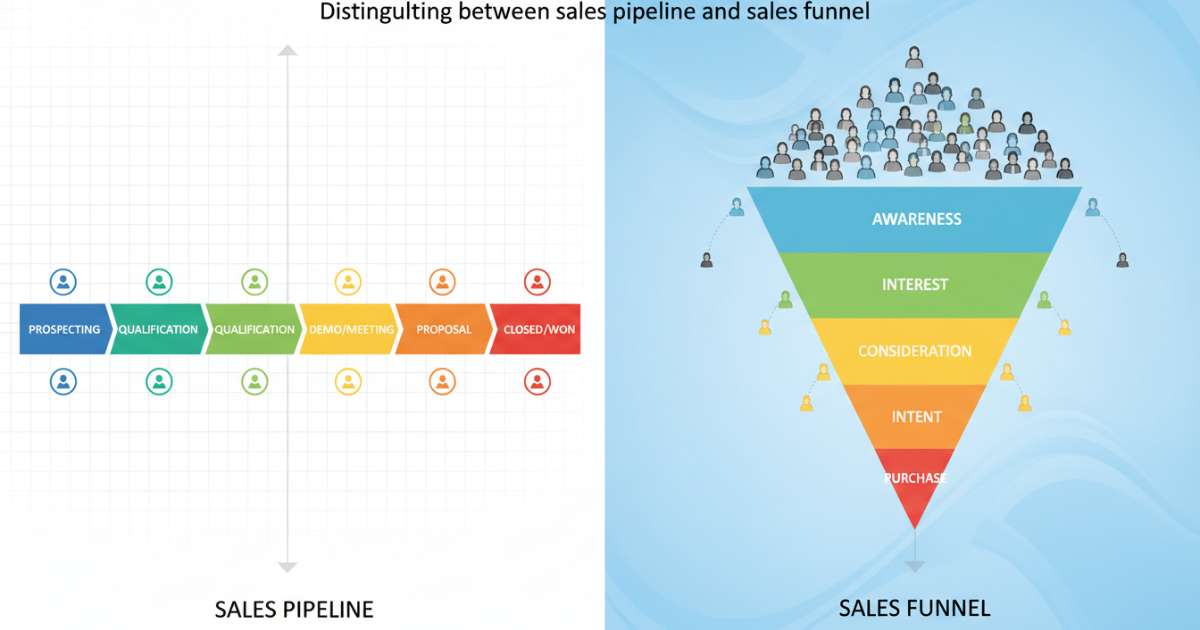
While people often use these terms interchangeably, there is a significant difference between a sales pipeline and a sales funnel. A sales pipeline focuses on the actions taken by the sales team to move a deal to completion. It is a process-oriented view that shows every stage of the transaction from the perspective of the seller. For example, it tracks how many calls were made, how many proposals were sent, and how many contracts are pending. It is a vital tool for sales management to monitor the activity and performance of individual representatives.
On the other hand, a sales funnel represents the journey of the customer and the volume of leads at each stage. It is usually shaped like a funnel because there are many prospects at the top but only a few become customers at the bottom. The funnel focuses on conversion rates and helps marketing teams understand where they are losing potential buyers. While the funnel tracks the customer mindset, the sales pipeline tracks the actual progress of the sales activities. Both are important, but they provide different types of data for business leaders.
Understanding this distinction allows a company to optimize both its marketing and its sales efforts. If the funnel is wide at the top but narrow in the middle, it might indicate that the marketing team is attracting the wrong audience. If the sales pipeline shows that many deals are stuck at the proposal stage, it might suggest that the sales team needs better training on negotiation or closing techniques. By analyzing both the sales pipeline and the funnel, a business can create a more cohesive strategy for revenue generation.
The structural perspective of a pipeline
The sales pipeline is essentially a set of stages that a salesperson follows to close a deal. It is very linear and focuses on the tasks that must be completed. Managers use the pipeline to see the total value of all open opportunities and to ensure that the team is following the correct procedures. It is a practical tool for day-to-day operations and provides a clear map for the sales staff to follow.
The conversion journey in a funnel
A funnel provides a broader view of how many people are dropping out of the process. It measures the effectiveness of lead generation and marketing campaigns. By looking at the funnel, you can see the percentage of people who move from awareness to interest, and then to a purchase. This data is crucial for calculating the return on investment for marketing spend and for identifying general trends in consumer behavior.
Essential strategies for sales pipeline management

Effective sales pipeline management is the key to maintaining a predictable income stream. One of the most important strategies is to perform regular pipeline cleaning. This means removing deals that have stayed in the same stage for too long without any progress. A cluttered sales pipeline can give a false sense of security, making it look like there is a lot of potential revenue when many of those deals are actually dead. By keeping the pipeline clean, managers can focus on active prospects who are genuinely interested in buying.
Another important strategy is to focus on the quality of the leads rather than just the quantity. It is better to have a smaller sales pipeline filled with high-probability deals than a massive one filled with leads that will never convert. Sales teams should be encouraged to disqualify leads quickly if they are not a good fit. This allows them to spend more time nurturing valuable relationships and providing better service to the prospects who are likely to sign a contract. Quality management leads to higher win rates and a more motivated sales force.
Shortening the length of the sales cycle is also a major objective in sales pipeline management. The longer a deal stays in the pipeline, the more likely it is to fall through. Salespeople should look for ways to move prospects through the stages more quickly by providing immediate value and maintaining frequent contact. Using automation tools can help by sending follow-up emails or reminders, ensuring that the sales pipeline moves at a steady pace. Reducing the time it takes to close a deal increases the overall capacity of the sales team to handle more work.
Regular pipeline cleaning and updates
Managers should review the sales pipeline at least once a week to identify stagnant deals. If a prospect has not responded to multiple attempts at communication, it may be time to move them to a nurture list or remove them entirely. This keeps the sales data accurate and helps the team stay realistic about their goals. Accurate reporting is only possible when the pipeline reflects the true state of the market.
Focusing on high quality leads
Prioritizing qualified leads ensures that the sales team is working on the most profitable opportunities. By using a lead scoring system, companies can rank prospects based on their level of interest and their fit with the product. High-scoring leads should receive the most attention, while low-scoring ones can be handled through automated marketing campaigns. This strategic approach maximizes the impact of the sales effort.
Shortening the length of the sales cycle
A fast-moving sales pipeline is usually a sign of a healthy business. By identifying bottlenecks in the process, companies can implement changes to speed up the transition from one stage to the next. For example, if the legal review of contracts is taking too long, streamlining that process can help close deals faster. Every day saved in the sales cycle adds up to significant gains over the course of a year.
Important metrics for monitoring sales pipeline health
To understand if your sales pipeline is working effectively, you must track specific metrics. The first metric is the total number of open opportunities. This tells you if you have enough potential business to meet your targets. If the number of opportunities is too low, it indicates a need for more lead generation activity. Conversely, if there are too many opportunities, the sales team might be overwhelmed, leading to a decrease in the quality of service provided to each prospect.
Average deal size is another crucial metric for sales pipeline analysis. By knowing the typical value of a deal, you can estimate how many sales are needed to reach your revenue goals. If the average deal size is decreasing, you may need to target larger clients or look for ways to upsell your existing products. Tracking the win rate is also essential, as it shows the percentage of deals that result in a successful sale. A low win rate might suggest that the sales team needs more training or that the product is not priced competitively.
Sales velocity is perhaps the most comprehensive metric for a sales pipeline. It measures how quickly deals move through the entire process and how much revenue is generated per day. This calculation considers the number of opportunities, the win rate, the average deal size, and the length of the sales cycle. A high sales velocity means the team is efficient and the business is growing rapidly. Monitoring these metrics allows managers to make data-driven decisions and adjust their sales strategy as needed to ensure long-term success.
Total number of open opportunities
This metric provides a snapshot of the current workload and potential revenue. It is important to maintain a balance between the top and bottom of the sales pipeline. If most deals are at the beginning stages, there might be a gap in revenue in the coming months. If most are at the end, the team needs to start prospecting immediately to avoid a future slowdown.
Average deal size and value
Understanding the value of each prospect helps in prioritizing the sales pipeline. Larger deals often require more time and resources, so they must be managed carefully. By tracking the average value, the company can forecast its cash flow more accurately and plan for future investments. This metric is also useful for evaluating the effectiveness of different marketing channels.
Win rate and conversion percentage
The win rate is a direct reflection of the sales team’s ability to close deals. By analyzing the conversion rate at each stage of the sales pipeline, you can find out exactly where prospects are leaving. If the conversion rate is low between the demo and the proposal, it might mean the presentation was not convincing enough. This detailed insight helps in targeted coaching for the sales staff.
Role of technology in optimizing the sales pipeline
In the modern business environment, technology plays a vital role in managing a sales pipeline. Customer Relationship Management (CRM) software is the most common tool used for this purpose. A CRM allows sales teams to store all customer information in one central location, making it easy to track interactions and progress. With a CRM, every member of the team can see the status of a deal in the sales pipeline, which improves collaboration and prevents duplicate work. It also provides powerful reporting features that automate the calculation of key metrics.
Automation is another significant benefit of using technology for sales pipeline management. Many repetitive tasks, such as sending follow-up emails, scheduling appointments, and updating deal statuses, can be automated. This frees up the sales team to focus on building relationships and closing deals. Automation ensures that no prospect is forgotten and that the sales process remains consistent across the entire organization. By reducing manual data entry, technology also improves the accuracy of the information within the sales pipeline.
Furthermore, advanced analytics and artificial intelligence are now being used to predict which deals are most likely to close. These tools analyze historical data from the sales pipeline to identify patterns and provide recommendations to the sales team. For example, AI might suggest the best time to contact a prospect or identify which leads should be prioritized based on their behavior. Using technology in this way gives businesses a competitive advantage and helps them manage their sales pipeline with much greater precision.
Automation of repetitive tasks
Automating the sales pipeline helps in maintaining a high level of activity without increasing the workload on the staff. Simple triggers can be set up to move a deal to the next stage once a specific action is completed. This ensures that the sales process is always moving forward. Automation also helps in gathering data for performance reviews without requiring manual input from the salespeople.
Centralized data storage for sales teams
Having a single source of truth for all sales pipeline information is essential for large teams. It prevents confusion and ensures that everyone is working with the same data. When a salesperson leaves the company, their potential deals can be easily transitioned to another team member because all the history and notes are stored in the system. This continuity is vital for maintaining customer trust.
Building a sustainable sales pipeline for long term growth
Creating a sales pipeline that delivers consistent results requires a long-term perspective. It is not just about closing the next deal, but about building a system that generates revenue year after year. One key element is the alignment between marketing and sales departments. When both teams work together, the lead generation efforts are more likely to produce prospects that fit the sales criteria. Marketing can provide the content and tools that sales needs at each stage of the sales pipeline to move deals forward.
Another important factor is the implementation of a consistent follow-up schedule. Many deals are lost simply because the salesperson did not follow up enough times. A sustainable sales pipeline relies on persistent and professional communication. Sales teams should have a clear plan for how often to contact prospects and what information to provide during each interaction. This discipline ensures that the sales pipeline remains active and that potential customers feel supported throughout their buying journey.
Finally, continuous training and development for the sales team are necessary to keep the sales pipeline healthy. The market is always changing, and sales techniques that worked yesterday might not work tomorrow. By investing in the skills of the sales staff, companies can ensure they are equipped to handle new challenges and use the sales pipeline effectively. A well-trained team is more confident, more efficient, and more successful at turning opportunities into revenue. Building a strong foundation today will lead to a more resilient and profitable sales pipeline in the future.
Aligning marketing and sales efforts
When marketing and sales are in sync, the sales pipeline becomes much more efficient. Marketing can create targeted campaigns that speak directly to the needs of the prospects that sales is trying to reach. This collaboration ensures that the sales pipeline is filled with leads that are already educated about the product, making the qualification and closing stages much easier for the sales team.
Implementing a consistent follow up schedule
Consistency is the key to successful sales pipeline management. A structured follow-up plan prevents prospects from falling through the cracks and shows that the company is reliable. By maintaining regular contact, the sales team can stay top-of-mind for the prospect, which is crucial when they are ready to make a purchasing decision. A disciplined approach to communication always leads to better results in the long run.
Finding the perfect office space is a critical step for any business looking to optimize its sales operations and manage a growing team. At King Office, we provide professional office environments that are designed to foster productivity and help you focus on expanding your sales pipeline. Our buildings are located in prime business districts, offering your company the prestige and accessibility it needs to attract top talent and impress potential clients. With flexible leasing options and modern amenities, King Office ensures that your workplace supports your business growth goals without unnecessary stress.
Choosing to rent an office through King Office means you are joining a community of successful professionals. Our dedicated support team is always available to assist with your needs, allowing you to spend more time on revenue generation and less on property management. Whether you are a small startup or a large corporation, we have the right space to accommodate your sales team and help you achieve long-term success. Contact us today to explore our available listings and take the first step toward a more professional and efficient working environment.
🌐 Website 1: https://thuetoanhahcm.com/
🌐 Website 2: https://www.facebook.com/kingoffice.vn