
Predictive analytics has become one of the most essential tools for modern organizations seeking to transform raw information into actionable insights. By using historical data, statistical algorithms, and machine learning techniques, businesses can identify the likelihood of future outcomes. This proactive approach allows companies to move beyond simply understanding what happened in the past to anticipating what will happen next. In an era where data is generated at an unprecedented rate, the ability to forecast trends and behaviors provides a significant competitive advantage. Organizations that effectively leverage predictive analytics can optimize their operations, reduce risks, and create highly personalized experiences for their customers.
Understanding the core concepts of predictive analytics

At its foundation, predictive analytics is a branch of advanced analytics that makes predictions about unknown future events. It relies on a variety of techniques from data mining, statistics, modeling, and artificial intelligence to analyze current data and make predictions about the future. The process begins with data collection from various sources, such as customer transactions, social media interactions, and sensor data from machinery. This information is then cleaned and organized to ensure accuracy before being processed by predictive modeling tools.
One of the most important aspects of this field is the use of historical data. Without a solid foundation of past performance, it is impossible to build accurate models. Predictive analytics software looks for patterns in this data to determine if they are likely to emerge again. For example, a retail company might analyze several years of holiday sales data to predict which products will be in high demand during the upcoming season. By identifying these patterns, the company can stock its inventory more efficiently and avoid both shortages and overstock situations.
The role of statistical algorithms and machine learning
The intelligence behind predictive analytics comes from sophisticated statistical algorithms. These mathematical formulas are designed to find relationships between variables. For instance, an algorithm might discover that there is a strong correlation between weather patterns and the sales of certain types of clothing. As technology has evolved, machine learning has taken these capabilities even further. Unlike traditional statistics, machine learning models can improve their accuracy over time as they are exposed to more data. This makes them incredibly powerful for complex tasks like image recognition, natural language processing, and high-frequency financial trading.
The importance of data quality in predictive modeling
The success of any predictive analytics project depends heavily on the quality of the input data. If the data is incomplete, outdated, or biased, the resulting predictions will be inaccurate. Data scientists spend a significant amount of time on data preparation, which involves removing duplicates, filling in missing values, and ensuring that the data is in a format that the predictive modeling software can understand. High-quality data ensures that the business intelligence derived from the models is reliable and can be used to make critical decisions with confidence.
Key techniques used in predictive modeling
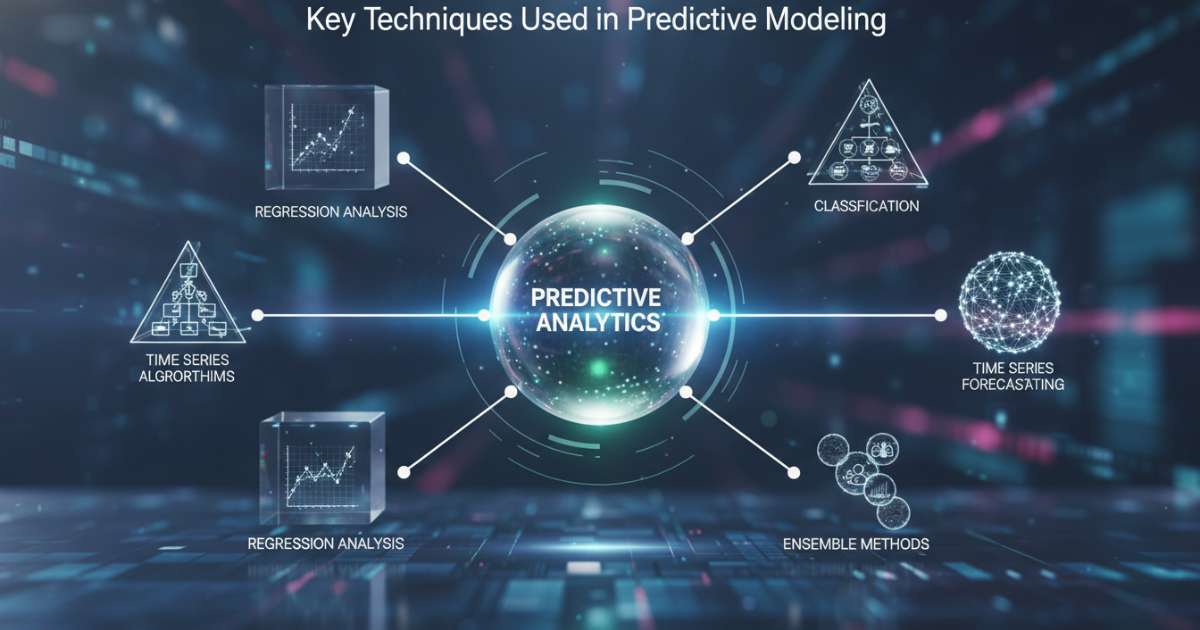
There are several different techniques used within predictive analytics depending on the type of question a business is trying to answer. These techniques are generally categorized into models that predict a specific value and models that categorize data into different groups. Choosing the right predictive modeling technique is essential for obtaining useful results. Most predictive analytics software packages include a variety of these models, allowing users to test different approaches to see which one provides the most accurate forecast.
Regression analysis is one of the most common techniques used in the industry. It is used to predict a continuous number, such as the future price of a stock or the expected temperature for a specific day. By analyzing the relationship between a dependent variable and one or more independent variables, regression models can estimate how changes in one factor will affect the outcome. This is particularly useful for financial forecasting and demand planning where precise numerical estimates are required.
Classification models for categorization
Another widely used technique in predictive analytics is classification. Instead of predicting a number, classification models assign data points to specific categories. For example, a bank might use a classification model to determine whether a loan applicant is a low risk or a high risk. These models analyze various factors like credit history, income level, and employment status to place the applicant into the most appropriate category. Machine learning algorithms such as decision trees and neural networks are frequently used for complex classification tasks because they can handle large amounts of non-linear data.
Time series analysis for trend prediction
Time series analysis is a specific type of predictive analytics that focuses on data points collected or recorded at specific time intervals. This technique is used to identify trends, seasonal patterns, and cyclic fluctuations over time. Businesses use time series models to forecast future sales, monitor equipment performance, and predict economic shifts. Because time series data is ordered chronologically, the models can account for the fact that past values often influence future values. This makes it a vital tool for any organization that needs to plan for the future based on historical trends.
Major benefits of implementing predictive analytics in business

Implementing predictive analytics offers a wide range of benefits that can transform how a business operates. By shifting from a reactive to a proactive mindset, organizations can anticipate challenges before they arise and seize opportunities more quickly than their competitors. The use of big data and advanced modeling allows leaders to make decisions based on evidence rather than intuition. This leads to more consistent results and a better understanding of the factors that drive success in their specific market.
One of the primary advantages is the improvement of operational efficiency. By using predictive analytics to forecast demand, companies can optimize their supply chains and reduce waste. For example, a manufacturing plant can use predictive modeling to determine when a piece of machinery is likely to fail. By performing maintenance just before the failure occurs, the company avoids costly downtime and extends the life of its equipment. This type of predictive maintenance is becoming a standard practice in industries like aviation, energy, and manufacturing.
Enhancing customer experience and retention
In the modern economy, customer experience is a key differentiator. Predictive analytics allows businesses to understand their customers on a much deeper level. By analyzing past purchase behavior and browsing history, companies can provide personalized recommendations that are highly relevant to each individual. This not only increases sales but also improves customer satisfaction. Furthermore, predictive modeling can identify customers who are at risk of leaving for a competitor. By identifying these individuals early, businesses can offer targeted incentives to retain them, significantly reducing churn rates.
Risk management and fraud detection
Managing risk is a critical function for any organization, especially in the financial and insurance sectors. Predictive analytics is an incredibly effective tool for identifying and mitigating potential threats. For instance, credit card companies use machine learning algorithms to analyze millions of transactions in real-time to detect fraudulent activity. If a transaction deviates from a user’s normal spending pattern, the system can flag it for review or block it immediately. Similarly, insurance companies use predictive modeling to assess the risk of a policyholder making a claim, allowing them to set premiums more accurately.
Common applications of predictive analytics across industries

The versatility of predictive analytics means that it can be applied to almost any industry that generates data. While the specific goals may vary, the underlying process of using historical data to forecast the future remains the same. As predictive analytics software becomes more accessible and easier to use, even smaller organizations are starting to adopt these techniques to improve their decision-making processes. The following examples highlight how different sectors are utilizing these powerful tools.
In the retail industry, predictive analytics is used for everything from inventory management to pricing optimization. Retailers analyze consumer trends and economic indicators to determine the best price for their products at any given time. This dynamic pricing strategy helps maximize profits while remaining competitive. Additionally, predictive modeling is used to design store layouts and marketing campaigns that resonate with specific demographic groups, leading to higher conversion rates and better brand loyalty.
Financial services and credit scoring
The financial services industry was one of the earliest adopters of predictive analytics. Banks and lending institutions rely on these models to evaluate the creditworthiness of individuals and businesses. By analyzing a wide range of variables, including payment history and current debt levels, predictive modeling provides a more accurate assessment of risk than traditional methods. Furthermore, investment firms use predictive analytics to identify market trends and develop trading strategies that can capitalize on small price movements in the stock market.
Healthcare and patient outcome prediction
In healthcare, predictive analytics has the potential to save lives and reduce costs. Hospitals use predictive modeling to identify patients who are at a high risk of developing chronic conditions or experiencing complications after surgery. By intervening early, doctors can provide better care and prevent emergency readmissions. Additionally, researchers use machine learning to analyze genetic data and identify potential targets for new drugs. This accelerates the drug discovery process and leads to more effective treatments for a variety of diseases.
Challenges when deploying predictive analytics software

While the benefits of predictive analytics are clear, deploying these systems is not without its challenges. Organizations often face significant hurdles when trying to integrate predictive modeling into their existing workflows. One of the most common issues is the lack of skilled personnel. Data science is a highly specialized field, and there is a global shortage of professionals who have the expertise to build and maintain complex models. This has led many companies to invest in predictive analytics software that is more user-friendly and requires less coding knowledge.
Another major challenge is data silos. In many large organizations, data is stored in different departments that do not communicate with each other. This makes it difficult to get a complete picture of the business and limits the effectiveness of predictive analytics. To overcome this, companies must invest in data mining and integration tools that can pull information from various sources into a centralized repository. Ensuring that the data is clean and consistent across the entire organization is a continuous process that requires significant resources and management support.
Privacy and ethical considerations
As predictive analytics becomes more powerful, it also raises important questions about privacy and ethics. The ability to predict individual behavior can be seen as an invasion of privacy if not handled correctly. Organizations must be transparent about how they collect and use data and ensure that they are complying with regulations like the GDPR. Furthermore, there is the risk of algorithmic bias. If the historical data used to train a model contains biases, the model will likely reproduce those biases in its predictions. This can lead to unfair treatment of certain groups in areas like hiring, lending, and law enforcement.
Managing expectations and model decay
It is also important for business leaders to manage expectations when it comes to predictive analytics. These models provide probabilities, not certainties. There will always be an element of uncertainty in any forecast, and unexpected events can render a model obsolete. This phenomenon is known as model decay. As the world changes, the patterns identified in historical data may no longer hold true. Therefore, predictive modeling is not a one-time task but a continuous cycle of monitoring, testing, and updating models to ensure they remain accurate in a changing environment.
Future trends in predictive analytics and big data
The future of predictive analytics is closely tied to the continued growth of big data and the evolution of artificial intelligence. As more devices become connected through the Internet of Things (IoT), the volume of data available for analysis will continue to explode. This will provide predictive analytics systems with even more granular information, allowing for even more precise forecasts. We are also seeing a trend toward the democratization of data, where predictive analytics software is becoming available to non-technical users through intuitive interfaces and automated features.
One of the most exciting developments is the rise of automated machine learning (AutoML). This technology automates many of the complex steps involved in building a predictive modeling system, such as feature selection and hyperparameter tuning. This allows organizations to deploy models much faster and reduces the reliance on highly specialized data scientists. As AutoML becomes more sophisticated, we can expect to see predictive analytics integrated into almost every aspect of business software, from CRM systems to ERP platforms.
Real-time predictive insights
Another significant trend is the shift toward real-time predictive analytics. In the past, many models were run in batches, meaning that the insights were based on data that was hours or even days old. However, in today’s fast-paced environment, businesses need to make decisions in milliseconds. Real-time predictive analytics allows companies to analyze data as it is generated and provide immediate responses. This is particularly important in areas like fraud detection, autonomous vehicles, and personalized digital advertising where timing is everything.
The integration of edge computing
To support real-time predictive analytics, more organizations are turning to edge computing. Instead of sending all data to a centralized cloud server for analysis, edge computing processes data locally on the device where it is generated. This reduces latency and allows for faster decision-making. For example, an industrial sensor can use predictive modeling to detect a malfunction and shut down a machine instantly, without waiting for a response from the cloud. The combination of predictive analytics and edge computing will enable a new generation of smart applications that are more responsive and efficient than ever before.
Finding the right environment to grow your business is just as important as the technology you use to drive it. At King Office, we understand that a professional and well-equipped workspace is the foundation for innovation and success. Our office buildings are designed to meet the needs of modern companies, providing the infrastructure and support required to implement advanced tools like predictive analytics. Whether you are a growing startup or an established enterprise, our flexible office solutions offer the perfect balance of comfort and functionality.
Choosing King Office means joining a community of forward-thinking professionals in a prime location. Our dedicated management team ensures that every detail of your office environment is handled with care, allowing you to focus entirely on your core business goals. With high-speed connectivity and modern amenities, our buildings are ready to support your data-driven journey. Contact us today to find the ideal office space that reflects the prestige and ambition of your brand.
🌐 Website 1: https://thuetoanhahcm.com/
🌐 Website 2: https://www.facebook.com/kingoffice.vn